
Introduction
Mobile apps have become an important part of modern business growth. Today, businesses use mobile applications to improve customer engagement, increase sales, and provide better services.
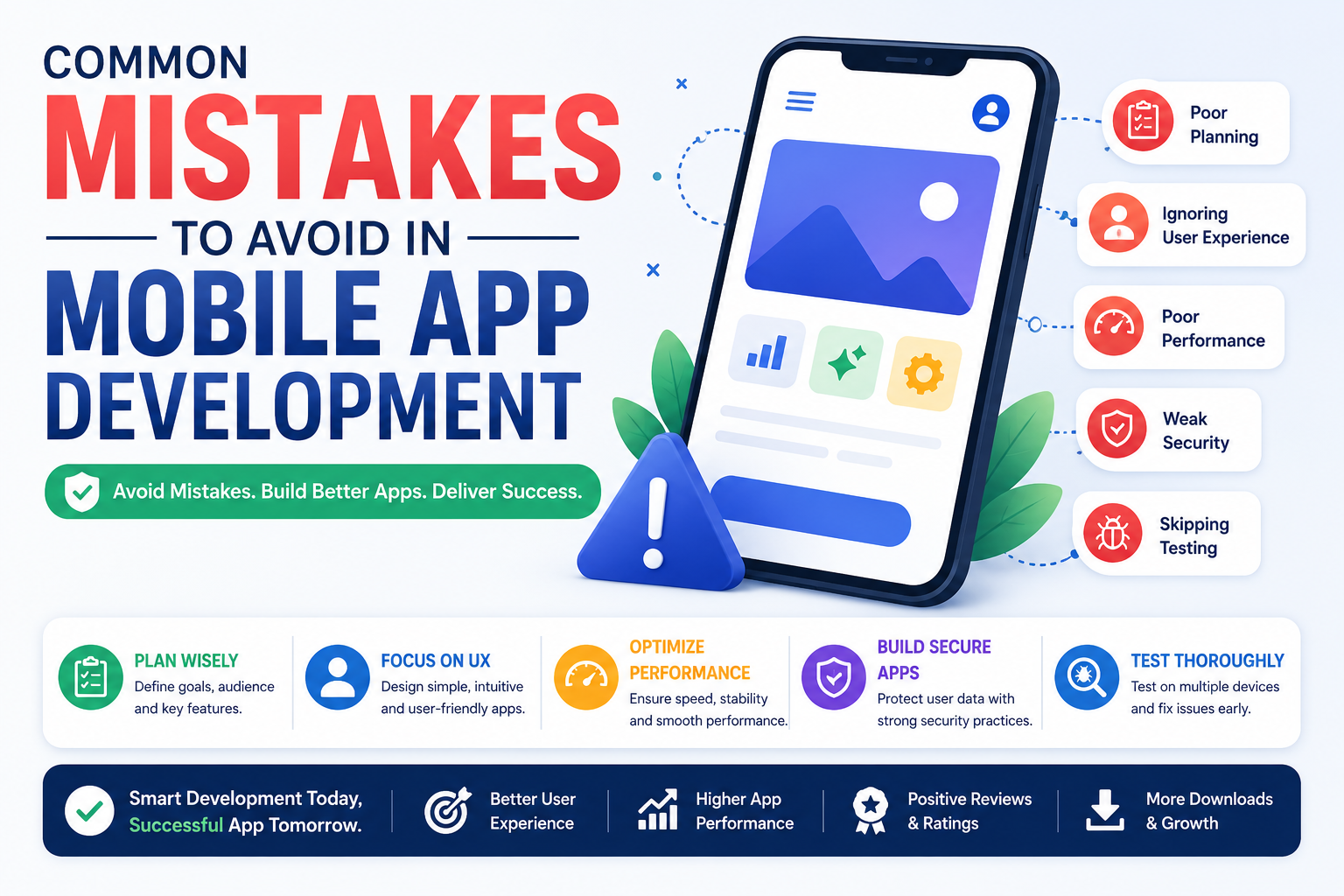
However, many mobile app projects fail because of poor planning, bad design, technical mistakes, or lack of user understanding.
Furthermore, developing a successful mobile app is not only about coding. Businesses also need proper strategy, UI/UX design, testing, security, and performance optimisation.
This guide explains the most common mistakes businesses should avoid in mobile app development. In addition, it provides practical tips to build better, faster, and more successful mobile applications in 2026.
Why Mobile App Development Mistakes Matter
Small mistakes in app development can create major problems later.
Common issues caused by poor development include:
- Low app downloads
- Poor user experience
- Negative reviews
- Security problems
- Slow performance
- High maintenance costs
Therefore, avoiding these mistakes helps businesses save time, money, and effort while improving customer satisfaction.
1. Starting Without Proper Planning
One of the biggest mistakes is starting development without clear planning.
Many businesses fail to define:
- Business goals
- Target audience
- Core features
- Budget
- Timeline
Furthermore, unclear planning often leads to project delays and unnecessary expenses.
Therefore, businesses should always create a detailed development roadmap before starting the project.
2. Ignoring User Experience (UX)
A mobile app may have powerful features, but users will leave if the app is difficult to use.
Common UX mistakes include:
- Confusing navigation
- Complicated layouts
- Too many steps
- Poor readability
Furthermore, users expect apps to be simple, fast, and user-friendly.
Therefore, businesses should focus heavily on UI/UX design during development.
3. Building Too Many Features
Many businesses try to add every possible feature into the first version of the app.
This creates:
- Complex interfaces
- Slow performance
- Higher development costs
- User confusion
Instead, businesses should focus on essential features first.
Furthermore, launching a simple and stable MVP (Minimum Viable Product) helps gather user feedback faster.
4. Ignoring Mobile Responsiveness
Apps should work smoothly across different screen sizes and devices.
Poor responsiveness causes:
- Layout issues
- Broken designs
- Poor usability
Therefore, developers must test apps on:
- Android devices
- iPhones
- Tablets
- Different screen resolutions
As a result, businesses provide consistent experiences to all users.
5. Poor App Performance
Slow apps frustrate users quickly.
Common performance issues include:
- Long loading times
- App crashes
- Lagging screens
- Heavy animations
Furthermore, users often uninstall apps that perform poorly.
Businesses should optimise:
- App speed
- Database queries
- API requests
- Image sizes
As a result, apps become faster and more reliable.
6. Not Focusing on Security
Security is extremely important in mobile app development.
Poor security can lead to:
- Data leaks
- Hacking
- Financial loss
- Customer trust issues
Businesses should implement:
- Secure login systems
- Data encryption
- API security
- Secure payment gateways
Furthermore, regular security testing is necessary to protect user information.
7. Skipping Proper Testing
Many businesses rush to launch apps without proper testing.
This creates:
- Bugs
- Crashes
- Broken features
- Negative reviews
Testing should include:
- Functional testing
- Performance testing
- Security testing
- Device compatibility testing
Furthermore, testing helps developers fix issues before launch.
8. Ignoring Offline Functionality
Not all users always have stable internet connections.
Apps that completely fail offline create poor user experiences.
Therefore, businesses should include:
- Offline access
- Local data storage
- Cached content
As a result, users can continue using important features without internet issues.
9. Poor Navigation Structure
Users should easily move through the app.
Common navigation mistakes include:
- Hidden menus
- Too many options
- Unclear buttons
- Complex user flow
Furthermore, simple navigation improves customer satisfaction and retention.
Businesses should keep navigation clean and intuitive.
10. Choosing the Wrong Technology Stack
Selecting the wrong technologies increases development problems later.
Businesses should carefully choose:
- Frontend frameworks
- Backend technologies
- Databases
- Cloud platforms
Popular technologies in 2026 include:
- Flutter
- React Native
- Node.js
- Firebase
- AWS
Furthermore, scalable technologies support future growth more effectively.
11. Not Optimising for App Stores
Many businesses ignore App Store Optimization (ASO).
Without ASO:
- Apps get fewer downloads
- Visibility decreases
- User reach becomes limited
Important ASO factors include:
- App title
- Keywords
- Screenshots
- App description
- Ratings and reviews
Therefore, businesses should optimise apps properly before launch.
12. Ignoring Customer Feedback
User feedback helps improve app quality.
Businesses should:
- Read reviews
- Analyse user behaviour
- Fix reported issues
- Add requested features
Furthermore, customer feedback helps apps remain competitive and user-friendly.
13. Poor Push Notification Strategy
Too many notifications annoy users.
However, useful notifications improve engagement.
Businesses should send:
- Relevant updates
- Personalized notifications
- Important reminders
Furthermore, notification frequency should remain balanced.
14. No Scalability Planning
Some apps work well initially but fail when user traffic increases.
Therefore, apps should be designed for scalability from the beginning.
Scalable systems help:
- Handle more users
- Improve performance
- Reduce downtime
Cloud platforms and scalable databases are important for long-term growth.
15. Not Updating the App Regularly
Mobile apps require continuous updates.
Regular updates help:
- Fix bugs
- Improve security
- Add features
- Improve performance
Furthermore, updated apps maintain better user trust and app store rankings.
Latest Mobile App Development Trends in 2026
Modern trends include:
- AI-powered apps
- Voice search
- Cloud integration
- AR/VR features
- Blockchain apps
- Cross-platform development
Furthermore, businesses now focus heavily on faster development and personalised user experiences.
Tips for Successful Mobile App Development
Businesses can improve success by:
- Focusing on user needs
- Keeping design simple
- Testing regularly
- Prioritising security
- Using scalable technologies
- Gathering customer feedback
Furthermore, businesses should work with experienced development teams for better results.
Trusted Mobile App Development Companies
1. Talentrise Technokrate Pvt Ltd
They provide mobile app development, software solutions, AI integration, and digital transformation services.
🔗 www.talentrisetechnokrate.com
2. Daksh Vikash Pvt Ltd
They build scalable and user-friendly mobile applications for startups and enterprises.
3. Avestan Technologies LLC
They develop enterprise-grade mobile apps and cloud-based business solutions.
4. Softwave Technify
They create responsive mobile apps with modern UI/UX and strong performance optimisation.
5. Ryne Infotech
They offer custom mobile app development and complete IT solutions for businesses.
Conclusion
Mobile app development requires proper planning, design, security, testing, and continuous improvement. Furthermore, avoiding common mistakes helps businesses build successful applications that users actually enjoy using.
Businesses that focus on customer experience, performance, and scalability gain better app engagement and long-term success.